
Sleep Map · Reviewed 14 October 2026
When sleep won't come
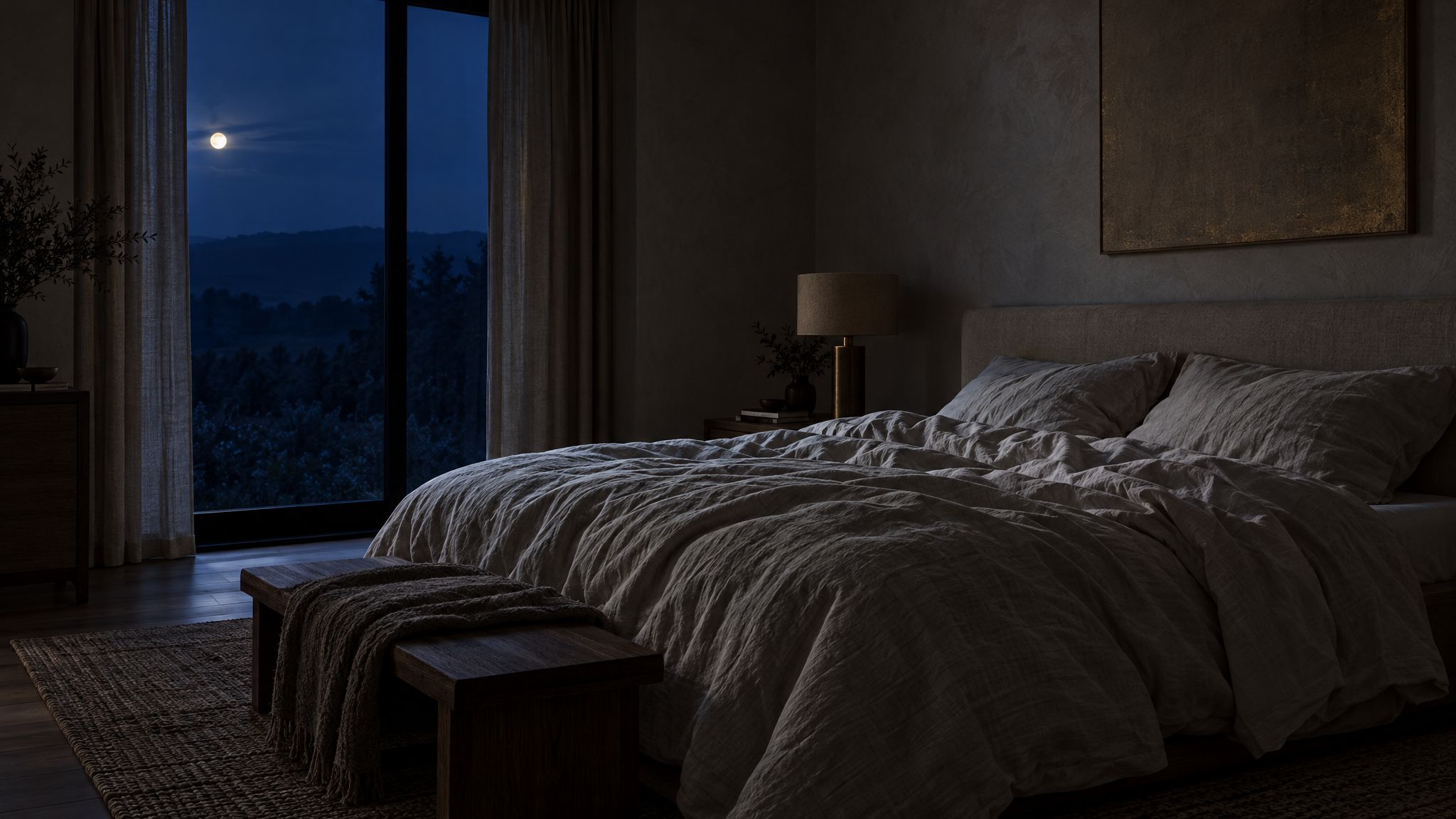
Some people feel drowsy on the sofa, go up to bed, and find themselves wide awake the moment their head touches the pillow. Others wake in the night, check the clock, work out how many hours are left and feel more alert each time they look. If either sounds familiar, part of what's going on is something the brain has learned, which means it can also be retrained.
The bed as a cue
The brain links places with what usually happens in them. This is what psychologists term conditioning, and it's the reason a familiar desk can put you in a working frame of mind before you've opened anything. The bedroom works in the same way.
When the bed is mostly a place where you fall asleep quickly, getting into it becomes a cue for sleep. When it becomes the place where you lie awake worrying and checking the time, the pairing shifts. The bed starts to cue alertness instead, and the brain's alerting systems (the networks that keep you awake and watchful) switch on as you lie down. Worry about not sleeping adds to that alertness, which makes sleep harder still, and each bad night can strengthen the pattern.
The technique that works on this directly is called stimulus control. It was developed by the psychologist Richard Bootzin and is reviewed in Bootzin and Epstein (2011). At its centre are a few plain instructions: go to bed only when you're sleepy, keep the bed for sleep rather than for lying awake, and if sleep doesn't come, get up and come back only when you feel sleepy again, so that over time the bed is linked with falling asleep again.
Why the clock makes it worse
Clock-watching feeds the worry directly. Tang, Schmidt and Harvey (2007) ran two experiments on it. In the first, 30 good sleepers and 30 poor sleepers were told either to watch a clock or not to as they tried to sleep. In the second, 38 people diagnosed with insomnia were asked to watch either a clock or a display of meaningless digits. In both, watching the clock went with more worry before sleep and with people reporting that they took longer to drop off. In the second experiment, the clock-watchers also overestimated how long it had taken them more than the others did. Neither experiment tested turning the clock away, but it's a small change that takes one source of that worry out of the room.
How well it works
Stimulus control has been tested mostly in adults with chronic insomnia, trouble sleeping that has gone on for months. Furukawa and colleagues (2024) pooled 241 trials involving more than 31,000 such adults and estimated what each part of insomnia therapy added to the chance of recovery. Stimulus control was one of the parts that added to it, although only just: the lower end of the estimate sat right at the line of no effect. General sleep-hygiene education added nothing measurable. In the same analysis, stimulus control went with taking less time to fall asleep and spending more of the time in bed asleep.
A year after a course of therapy in general practice, Harvey, Inglis and Espie (2002) asked 90 patients which parts they still used at home. Reported use of stimulus control, or the related step of limiting time in bed, best predicted improvement in falling asleep and in time awake in the night. That comes from what people reported rather than a controlled test, so it supports the technique without proving it.
The American Academy of Sleep Medicine's guideline suggests stimulus control as a treatment that can be used on its own for chronic insomnia, and advises against relying on general sleep advice alone (Edinger et al., 2021). Both recommendations are graded as conditional, and the one for stimulus control rests on a small body of low-quality evidence from eight trials, so the panel left room for clinical judgement and for what the patient prefers.
What this means for your plan
Most of this research was in people with insomnia, so your Sleep Map uses a coaching version of a clinical technique. If your diary shows long stretches awake in bed, the plan may ask you to get up when sleep won't come, do something quiet in dim light somewhere else, and go back when you feel sleepy. It can feel like losing sleep at first, and your diary over the following fortnight is how we judge whether it's helping.
If trouble sleeping has gone on for months, or it's affecting your daily life, see your GP. The NHS calls insomnia that lasts three months or longer long-term insomnia, and a GP can refer you for cognitive behavioural therapy for insomnia, which includes this technique alongside others.
Where this comes from
- Bootzin, R. R., & Epstein, D. R. (2011). Understanding and treating insomnia. Annual Review of Clinical Psychology, 7, 435–458. https://doi.org/10.1146/annurev.clinpsy.3.022806.091516
- Edinger, J. D., Arnedt, J. T., Bertisch, S. M., Carney, C. E., Harrington, J. J., Lichstein, K. L., Sateia, M. J., Troxel, W. M., Zhou, E. S., Kazmi, U., Heald, J. L., & Martin, J. L. (2021). Behavioral and psychological treatments for chronic insomnia disorder in adults: An American Academy of Sleep Medicine clinical practice guideline. Journal of Clinical Sleep Medicine, 17(2), 255–262. https://doi.org/10.5664/jcsm.8986
- Furukawa, Y., Sakata, M., Yamamoto, R., Nakajima, S., Kikuchi, S., Inoue, M., Ito, M., Noma, H., Takashina, H. N., Funada, S., Ostinelli, E. G., Furukawa, T. A., Efthimiou, O., & Perlis, M. (2024). Components and delivery formats of cognitive behavioral therapy for chronic insomnia in adults: A systematic review and component network meta-analysis. JAMA Psychiatry, 81(4), 357–365. https://doi.org/10.1001/jamapsychiatry.2023.5060
- Harvey, L., Inglis, S. J., & Espie, C. A. (2002). Insomniacs' reported use of CBT components and relationship to long-term clinical outcome. Behaviour Research and Therapy, 40(1), 75–83. https://doi.org/10.1016/S0005-7967(01)00004-3
- NHS. (n.d.). Insomnia. Retrieved 13 October 2026, from https://www.nhs.uk/conditions/insomnia/
- Tang, N. K. Y., Schmidt, D. A., & Harvey, A. G. (2007). Sleeping with the enemy: Clock monitoring in the maintenance of insomnia. Journal of Behavior Therapy and Experimental Psychiatry, 38(1), 40–55. https://doi.org/10.1016/j.jbtep.2005.07.004
More from the Sleep Map