
Sleep Map · Reviewed 14 October 2026
An evening routine that works
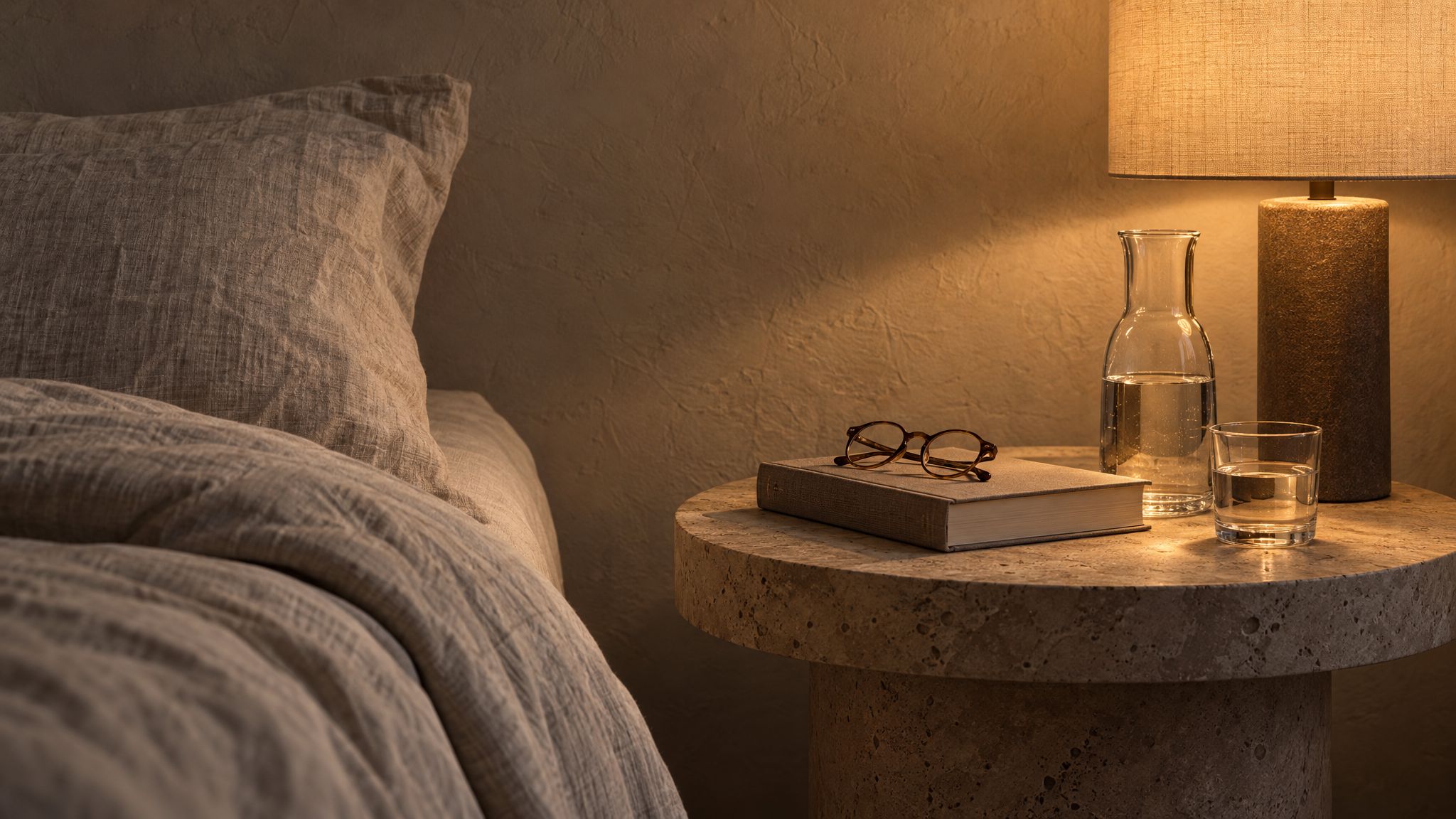
Arriving at lights out with the mind still running is the problem an evening routine is meant to solve. Turning the lamp off halfway through tomorrow's list, or answering one last message in bed and then lying there wide awake, is what it looks like in practice.
Why the order matters more than the clock
Sleep comes when the brain's alerting systems stand down. Worry and mental checking at bedtime keep them running, and lying awake then gives you more to worry about. Harvey (2002) put that loop at the centre of her cognitive model of insomnia, in which worry about sleep switches on the body's automatic stress response and keeps it on.
A routine works on this through habit. Wood and Neal (2007) describe how an action becomes tied to the setting it happens in and to the action before it, until the setting alone sets it off without a decision. Repeat the same steps in the same order and the sequence becomes the cue: bath, then the list, then teeth, then bed, and the brain begins to wind down before you're under the covers. This is why your plan cares about the order and is relaxed about exact times.
We should be honest here. No trial in adults has tested "having a routine" as the treatment. The nearest is a small British study in which 24 adults sleeping under six hours a night mapped out their usual evening with a researcher and planned a better sequence for the following week (Mohideen et al., 2023). Nobody dropped out and most changed part of their routine, but it was a feasibility study with no comparison group, so it shows the approach is workable rather than how much it helps. The case for each step rests on the research behind that step.
The steps, counted back from lights out
Lamps go low from about three hours before your usual lights out. Light reaches the body clock through cells at the back of the eye that contain melanopsin (a light-sensitive pigment), and bright light in the evening holds back melatonin, the hormone that signals night. Gooley and colleagues (2011) kept 116 young adults in a research unit; compared with dim light, ordinary room light before bed delayed the evening rise of melatonin in 99% of them and shortened the body's signal of night by about 90 minutes. An international expert group recommends dimmer light from at least three hours before bed (Brown et al., 2022).
A warm bath or shower fits one to two hours before bed. Warm water opens the blood vessels in the skin (vasodilation), and heat then drains out through the hands and feet, so core temperature falls faster in the hours that follow. Warm skin also appears to signal sleep in its own right: when Raymann and colleagues (2005) warmed the skin of the trunk (proximal skin, away from the hands and feet) in eight healthy adults by less than a degree, within the comfortable range and without moving core temperature, they fell asleep about a quarter faster. Warming the hands and feet alone, or nudging core temperature, did nothing measurable, so in that study the signal came from warmth over the trunk rather than at the extremities. Pooling 13 studies, Haghayegh and colleagues (2019) found water at 40 to 42.5 °C, one to two hours before bed and for as little as 10 minutes, shortened the time taken to fall asleep. At home, in 23 adults, a 16-minute bath did better than a shower (Maeda et al., 2023). Keep it warm rather than scalding; if you're pregnant, have a heart condition or feel faint in hot water, keep it cooler and shorter.
Write tomorrow's to-do list on paper, out of bed. In a sleep laboratory, 57 young adults spent five minutes writing either a to-do list or a list of things they'd already done. The to-do group fell asleep faster, and the more specific the list, the faster they dropped off (Scullin et al., 2018). It was one night, and it compared two kinds of writing rather than writing with doing nothing.
Then the phone goes out of the bedroom. In a pilot trial of 38 university students who already slept poorly and used their phones in bed, leaving the phone alone for the last 30 minutes improved how well they said they slept over four weeks (He et al., 2020). Taking it out of the room is our extension of that finding.
Teeth come last, and then bed.
No scores, and no perfect nights
Your plan doesn't score the routine. Sleep is largely automatic, and Espie and colleagues (2006) argued that close attention to it, and effort to make it happen, can get in its way. Trying hard to sleep tends to keep you awake. Miss a step, or a whole evening, and pick it up the next night; your diary will show whether the time it takes you to fall asleep comes down.
If changing your habits hasn't helped, or you've had trouble sleeping for months, see your GP, who may offer cognitive behavioural therapy (NHS, 2024). Our article on long-running sleep problems explains what that involves.
Where this comes from
- Brown, T. M., Brainard, G. C., Cajochen, C., Czeisler, C. A., Hanifin, J. P., Lockley, S. W., Lucas, R. J., Münch, M., O'Hagan, J. B., Peirson, S. N., Price, L. L. A., Roenneberg, T., Schlangen, L. J. M., Skene, D. J., Spitschan, M., Vetter, C., Zee, P. C., & Wright, K. P. (2022). Recommendations for daytime, evening, and nighttime indoor light exposure to best support physiology, sleep, and wakefulness in healthy adults. PLoS Biology, 20(3), e3001571. https://doi.org/10.1371/journal.pbio.3001571
- Espie, C. A., Broomfield, N. M., MacMahon, K. M. A., Macphee, L. M., & Taylor, L. M. (2006). The attention–intention–effort pathway in the development of psychophysiologic insomnia: A theoretical review. Sleep Medicine Reviews, 10(4), 215–245. https://doi.org/10.1016/j.smrv.2006.03.002
- Gooley, J. J., Chamberlain, K., Smith, K. A., Khalsa, S. B. S., Rajaratnam, S. M. W., Van Reen, E., Zeitzer, J. M., Czeisler, C. A., & Lockley, S. W. (2011). Exposure to room light before bedtime suppresses melatonin onset and shortens melatonin duration in humans. Journal of Clinical Endocrinology and Metabolism, 96(3), E463–E472. https://doi.org/10.1210/jc.2010-2098
- Haghayegh, S., Khoshnevis, S., Smolensky, M. H., Diller, K. R., & Castriotta, R. J. (2019). Before-bedtime passive body heating by warm shower or bath to improve sleep: A systematic review and meta-analysis. Sleep Medicine Reviews, 46, 124–135. https://doi.org/10.1016/j.smrv.2019.04.008
- Harvey, A. G. (2002). A cognitive model of insomnia. Behaviour Research and Therapy, 40(8), 869–893. https://doi.org/10.1016/S0005-7967(01)00061-4
- He, J.-W., Tu, Z.-H., Xiao, L., Su, T., & Tang, Y.-X. (2020). Effect of restricting bedtime mobile phone use on sleep, arousal, mood, and working memory: A randomized pilot trial. PLoS ONE, 15(2), e0228756. https://doi.org/10.1371/journal.pone.0228756
- Maeda, T., Koga, H., Nonaka, T., & Higuchi, S. (2023). Effects of bathing-induced changes in body temperature on sleep. Journal of Physiological Anthropology, 42(1), 20. https://doi.org/10.1186/s40101-023-00337-0
- Mohideen, A., Bouvin, C., Judah, G., Picariello, F., & Gardner, B. (2023). Feasibility and acceptability of a personalised script-elicitation method for improving evening sleep hygiene habits. Health Psychology and Behavioral Medicine, 11(1), 2162904. https://doi.org/10.1080/21642850.2022.2162904
- NHS. (2024). Insomnia. Retrieved 13 October 2026, from https://www.nhs.uk/conditions/insomnia/
- Raymann, R. J. E. M., Swaab, D. F., & Van Someren, E. J. W. (2005). Cutaneous warming promotes sleep onset. American Journal of Physiology: Regulatory, Integrative and Comparative Physiology, 288(6), R1589–R1597. https://doi.org/10.1152/ajpregu.00492.2004
- Scullin, M. K., Krueger, M. L., Ballard, H. K., Pruett, N., & Bliwise, D. L. (2018). The effects of bedtime writing on difficulty falling asleep: A polysomnographic study comparing to-do lists and completed activity lists. Journal of Experimental Psychology: General, 147(1), 139–146. https://doi.org/10.1037/xge0000374
- Wood, W., & Neal, D. T. (2007). A new look at habits and the habit-goal interface. Psychological Review, 114(4), 843–863. https://doi.org/10.1037/0033-295X.114.4.843
More from the Sleep Map