
Sleep Map · Reviewed 14 October 2026
Your bedroom and sleep
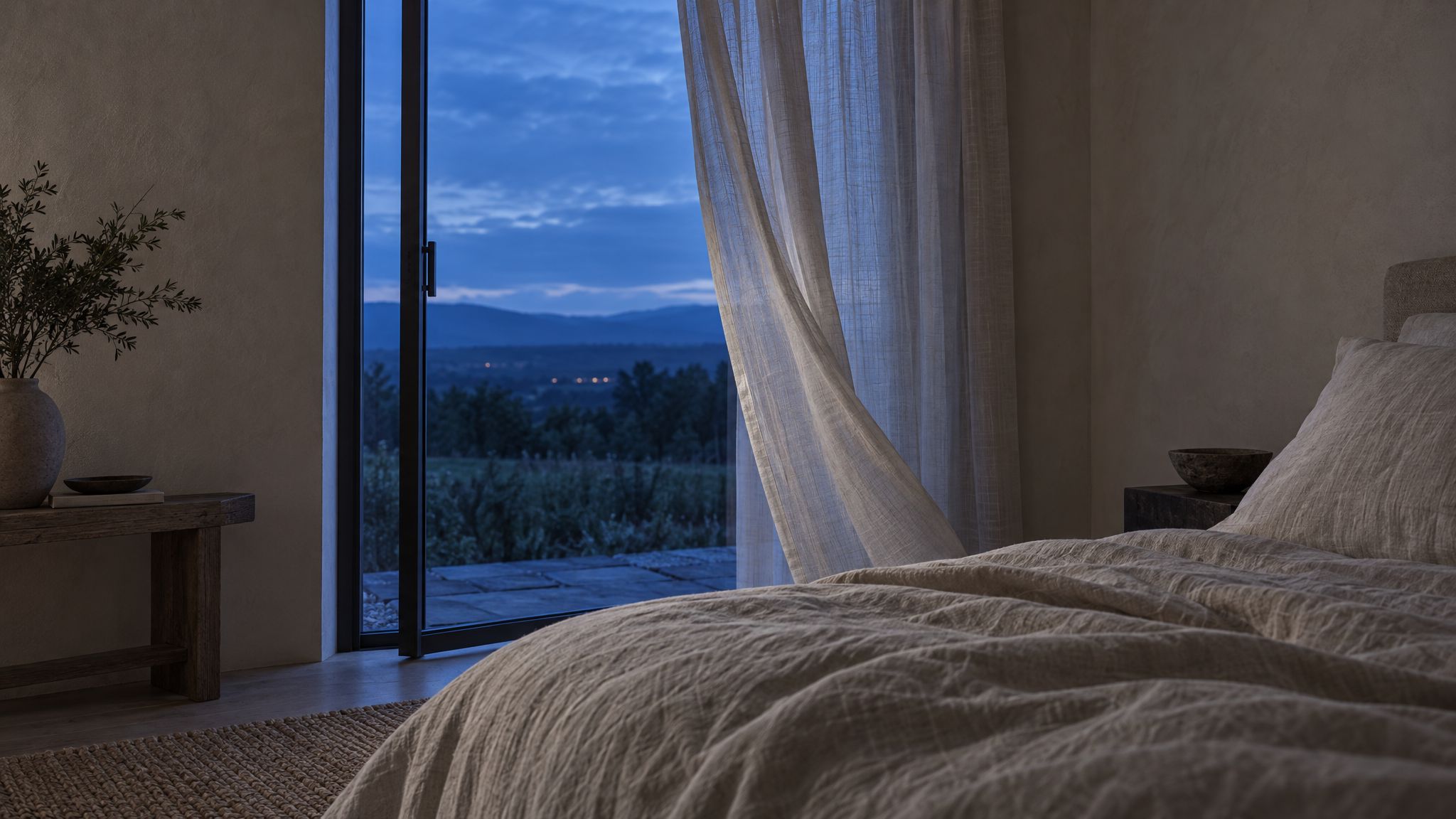
The bedroom has a say in how you sleep, and most of us know it from a close summer night spent on top of the duvet, or from waking in the small hours without knowing what did it. Heat, light and noise each reach a different part of the machinery that runs sleep, so we take them one at a time.
Heat has to leave the body
Your core temperature (the temperature deep inside you) falls through the evening, and that fall travels alongside the body's signal for sleep. To lose the heat, blood vessels in the hands and feet widen, a process called vasodilation, so warm blood runs close to the skin and the heat escapes. In a laboratory study, Kräuchi and colleagues (2000) found that how much heat people were losing through their hands and feet predicted how quickly they fell asleep better than core temperature, heart rate, melatonin or how sleepy they said they felt.
A warm room or a heavy duvet narrows that route out. Reviewing the laboratory work, Okamoto-Mizuno and Mizuno (2012) found that when people slept with bedding and clothing, as they would at home, heat increased time awake and cut both deep sleep and REM sleep (the dreaming stage), and humid heat made it worse. Cold behaved differently. With enough bedding, a cooler room didn't change the stages of sleep, because the warmth under the covers holds fairly steady. What we're after, then, is cool air in the room and bedding that keeps you comfortable inside it.
Light while you sleep
The body clock learns about light through cells at the back of the eye that contain melanopsin (a light-sensitive pigment, separate from the cells you see with). Closed eyelids let only a small fraction of light through, so the question is whether that fraction matters.
Mason and colleagues (2022) tested it in 20 healthy young adults sleeping in a laboratory. Half spent one night under overhead room lighting at 100 lux (lux measures how much light falls on a surface; this is a normally lit room), the rest in near darkness. Under the light, heart rate stayed higher all night, the balance of the nervous system tipped towards its alerting side, a smaller share of the night went to deep and dreaming sleep, and the next morning their bodies needed more insulin to deal with a sugary drink. Their melatonin didn't differ from the dark group's. That's one night, in 20 people, under light far brighter than a standby LED or a street lamp behind curtains, so it tells us which way the effect runs more than how big it is in your bedroom.
The practical advice comes from an international group of light and sleep researchers, who recommend keeping the sleeping environment as dark as possible (Brown et al., 2022). That's a consensus drawn from the research rather than a trial of blackout blinds. The NHS suggests the same, with curtains, blinds or an eye mask (NHS, 2024).
Noise and what to do about it
Sound is processed even when you're asleep, and a passing lorry or a slammed door can pull you into lighter sleep without fully waking you. In the review of night-time noise written for the World Health Organization, each 10-decibel rise in road, rail or air traffic noise raised the odds of people saying noise badly disturbed their sleep, and in studies that recorded sleep in people's own homes it raised the odds of waking (Basner & McGuire, 2018).
Remedies have had far less testing. Basner and colleagues (2026) brought 25 healthy adults into a laboratory for seven nights and played bursts of recorded environmental noise while they slept. Earplugs offset nearly all of the noise's effect on sleep until it reached its loudest level. Pink noise, a steady hiss of the kind many sound machines play, reduced dreaming sleep on its own and, played over the bursts, left the night's sleep worse overall. It's one laboratory study, but it's the most direct test we have, and it's why your plan suggests earplugs rather than a sound machine.
Where your plan starts
We start with whatever your answers and diary point to first, which is most often heat, and change one thing at a time: a lighter duvet or a cooler room, then the light (blocking street light, covering standby lights), then noise. Your diary will show whether time awake in the night comes down. If earplugs aren't comfortable, or you need to hear a child or an alarm, tell us and we'll look at the room instead.
Hot flushes and night sweats are a different matter. A cooler room can make them easier to bear but can't stop them, so if they're waking you, raise them with your GP.
Where this comes from
- Basner, M., & McGuire, S. (2018). WHO environmental noise guidelines for the European Region: A systematic review on environmental noise and effects on sleep. International Journal of Environmental Research and Public Health, 15(3), 519. https://doi.org/10.3390/ijerph15030519
- Basner, M., Smith, M. G., Cordoza, M., Kayser, M. S., Carlin, M., Ecker, A. J., Gilad, Y., Park-Chavar, S., Rennie, K., Schneller, V., Walsh, S., Shou, H., Cao, Q., Younes, M., Aeschbach, D., & Jones, C. W. (2026). Efficacy of pink noise and earplugs for mitigating the effects of intermittent environmental noise exposure on sleep. Sleep, 49(5), zsag001. https://doi.org/10.1093/sleep/zsag001
- Brown, T. M., Brainard, G. C., Cajochen, C., Czeisler, C. A., Hanifin, J. P., Lockley, S. W., Lucas, R. J., Münch, M., O'Hagan, J. B., Peirson, S. N., Price, L. L. A., Roenneberg, T., Schlangen, L. J. M., Skene, D. J., Spitschan, M., Vetter, C., Zee, P. C., & Wright, K. P. (2022). Recommendations for daytime, evening, and nighttime indoor light exposure to best support physiology, sleep, and wakefulness in healthy adults. PLoS Biology, 20(3), e3001571. https://doi.org/10.1371/journal.pbio.3001571
- Kräuchi, K., Cajochen, C., Werth, E., & Wirz-Justice, A. (2000). Functional link between distal vasodilation and sleep-onset latency? American Journal of Physiology: Regulatory, Integrative and Comparative Physiology, 278(3), R741–R748. https://doi.org/10.1152/ajpregu.2000.278.3.R741
- Mason, I. C., Grimaldi, D., Reid, K. J., Warlick, C. D., Malkani, R. G., Abbott, S. M., & Zee, P. C. (2022). Light exposure during sleep impairs cardiometabolic function. Proceedings of the National Academy of Sciences, 119(12), e2113290119. https://doi.org/10.1073/pnas.2113290119
- NHS. (2024). Insomnia. Retrieved 13 October 2026, from https://www.nhs.uk/conditions/insomnia/
- Okamoto-Mizuno, K., & Mizuno, K. (2012). Effects of thermal environment on sleep and circadian rhythm. Journal of Physiological Anthropology, 31, 14. https://doi.org/10.1186/1880-6805-31-14
More from the Sleep Map